At the entrance to Solomon’s temple stand two pillars, named and set apart. They do not support the structure in a practical sense, but they carry symbolic weight, marking the threshold of God’s dwelling.
Their presence invites interpretation. Positioned together, they frame the approach to the temple and speak of stability, establishment, and witness.
This essay considers how these pillars may be understood in light of the Passion, and how they point beyond themselves to the work of Christ.
“King Solomon sent and brought Hiram. He was the son of a widow, and his father a worker in bronze. And he was full of wisdom, understanding, and skill for making any work in bronze. He cast two pillars of bronze. Eighteen cubits was the height of one pillar, and a line of twelve cubits measured its circumference. It was hollow, and its thickness was four fingers. He also made two capitals of cast bronze to set on the tops of the pillars. The height of the capital was five cubits. There were lattices of checker work with wreaths of chain work for the capitals; he made pomegranates in two rows around the one latticework to cover the capital. He set up the pillars at the vestibule of the temple. He set up the pillar on the south and called its name Jachin, and he set up the pillar on the north and called its name Boaz. And on the tops of the pillars was lily-work.” (1 Kings 7:13–22) (edited for brevity)
God gives Moses details for building a temporary, moveable tabernacle in the desert: “Exactly as I show you concerning the pattern of the tabernacle, and of all its furniture, so you shall make it” (Exodus 25:9). Later, when Solomon builds a permanent temple, these two pillars are added. But they are added still under God’s design, for in David’s instruction to Solomon he says, “All this he made clear to me in writing from the hand of the LORD, all the work to be done according to the plan” (1 Chronicles 28:19). And the design of these pillars are not Hiram’s, for his chief artisan is “to do all sorts of engraving and execute any design that may be assigned him” (2 Chronicles 2:14).
The tabernacle and temple are similarly furnished and serve the same ultimate purpose: to house the ark and provide a place for the glory of God to dwell. However, since the desert tabernacle was temporary and subject to transport at a moment’s notice, it had moveable pillars of fire by day and a cloud by night. These eventually lead the Israelites into the Promised Land, where these permanent structures are erected, indicating a permanent home.
The temple is furnished with items made from specially chosen materials and colors. Hebrews says these have lessons for us as “copies of the true things” (Hebrews 9:23-24) in heaven, anticipating Jesus’ work on the cross. The pillars are named Jachin and Boaz and stand out among the other temple furniture. Scholars suggest various reasons for the pillars’ presence in front of the temple. These include the two named trees in Eden (of life, of the knowledge of good and evil), representations of the mountains of God (Zion, Sinai), copies of foreign temples, and even prophetically, of Peter and Paul establishing the early church for Jews and Gentiles.
Solomon’s Temple pillars are unique in several ways, all of which inform their purpose. They are built first, seen first, uniquely proportioned, and freestanding, supporting no part of the building. The delicate detail is at the top, high above the worshipper. Most significantly, they are each given a proper name–as though representing a person. No other parts or furnishings of the temple are given proper names. But these pillars reveal the depth of God’s justice and mercy through Jesus Christ on the cross, foreshadowing his Passion.
Built First and Built High
These two pillars are built first and are the first items a worshipper sees when drawing near God’s glory in the temple. They are placed at the vestibule of the temple on the east side, the side on which the tribe of Judah used to encamp in the desert, the tribe from which Jesus descended as noted in two gospels. Thirty-five feet high, they are seen from a great distance. In the fifteen Psalms of Ascents, we read: “I lift up my eyes to the hills…my help comes from the Lord…Jerusalem to which the tribes go up…To you I lift up my eyes…my eyes are not raised too high…O Israel, hope in the Lord” (Psalms 121:1, 2, 122:4, 123:4, 131:1, 3). These are but a few meditations of those who approach the temple.
Like those worshippers, we also draw near to Jesus, who was raised upon the cross and then raised from the dead, trusting in him for our deliverance. These pillars rise so that we can say, “I see him, but not now; I behold him, but not near: a star shall come out of Jacob” (Numbers 24:17). If the pillars are still standing in the dawn’s light, then the whole of God’s dwelling is still there, along with the hope of God’s mercy.
Bronze
Made with bronze, the same material as the altar, it conveys a similar message: the judgment of and salvation from our sins are seen in these pillars. Engineers have considered making hollow metal pillars of this height and suggest that accomplishing this may have required an inner lining of wood to support them. We see Jesus’ humanity and judgment on a cross in this wood and bronze.
Four Fingers
The pillars are hollow inside, with walls four fingers thick. This is unusual, as pillars are typically made from solid stones for structural integrity and durability. The Greek Parthenon still stands on such pillars. In ancient times, “pillars were sometimes made from one block, but generally from several stones placed one on top of the other.” These pillars are hollow but would not remain empty. When the disciples’ mother asks for her sons to sit next to him in his kingdom, Jesus answers, “You do not know what you are asking. Are you able to drink the cup that I am to drink?” (Matthew 20:22). And then in Gethsemane, he prays, “My soul is very sorrowful, even to death, My Father, if it be possible, let this cup pass from me; nevertheless, not as I will, but as you will” (Matthew 26:38-42). Jesus “emptied himself, by taking the form of a servant, being born in the likeness of man” (Philippians 2:7); he then takes on all our sin, his cup filled wholly with the wrath of God’s judgment meant for us.
The Psalmist prophetically writes the words Jesus may have said in Gethsemane, “Your wrath lies heavy upon me, and you overwhelm me with all your waves” (Psalms 88:39). This is not the “good wine” (John 2:10) of his first miracle at Cana but the dark wine of God’s wrath that Jesus drinks to the bitter dregs as the gall offered him on the cross (Psalms 69:21, Matthew 27:34). He drinks it so that we need not, but that we may drink the new wine with him in his Father’s kingdom (Matthew 26:29).
The Encyclopaedia Judaica says, “The measurement of the handbreadth was the width of four fingers.” This handbreadth may represent our short life on this earth, as described in the Psalms, “Behold, you have made my days a few handbreadths, and my lifetime is as nothing before you” (Psalms 39:5). But when the immortal Son chooses this mortal life among tax collectors and sinners, this Psalm may be his prayer as he sees the day of his crucifixion approaching. The four-fingered walls of these pillars represent the mortality he chose and the shortened life Jesus lived.
The sound of a horn is used for ritual calls to worship. Leviticus speaks of “a memorial proclaimed with blast of trumpets, a holy convocation” (Leviticus 23:24). The Koren Talmud explains that “only an animal horn that is naturally hollow, for example, that of a ram or goat, may be used for these purposes.” But an additional requirement is put upon the horn: it must be of a specific size. “The minimum length is enough that when one holds it in his hand with four fingers, it can be seen protruding from both sides of his fingers.” The hollow pillars, wrapped in four fingers of bronze, are the trumpets that call the world to come to Jesus: “And when the burnt offering began, the song to the LORD began also, and the trumpets” (2 Chronicles 29:27).
Earlier, a horn had sounded when the walls of Jericho fell, and now sounds at the wall’s fall between God and us. When our Savior returns, we will see that the “seventh angel blew his trumpet, and there were loud voices in heaven, saying, The kingdom of the world has become the kingdom of our Lord and of his Christ, and he shall reign forever and ever” (Revelation 11:15). Jesus, as prefigured in the hollow pillars with walls four fingers thick, took on our “human form” (Philippians 2:8) to bear God’s wrath and proclaim victory over death.
Dimensions
Research suggests the cross might have looked like a “T” or a “t” or a “+” or an “X” or even just a single pole. Historians have dug deep into ancient records to unearth details. Although definitive proof of the exact dimensions does not exist, scriptural evidence supports the general shape we know today. For example, when Thomas says, “unless I see in his hands the mark of the nails [plural]” (John 20:25), he indicates that two nails were used on either side of a horizontal bar. “And over his head they put the charge against him, which read, ‘This is Jesus, the King of the Jews’” (Matthew 27:37), which indicates that the vertical post extended above the horizontal bar. The vertical bar would naturally be longer than the horizontal bar to accommodate body dimensions and allow the pole to fit securely into the ground, giving it the common “t” shape we are familiar with today.
Jachin and Boaz have unique proportions that point to the cross. “Eighteen cubits was the height of one pillar, and a line of twelve cubits measured its circumference” (1 Kings 7:15). If this tubular pillar were to be unrolled like a rug, the vertical and horizontal ratio would be the same as a traditional Christian cross: “A horizontal crosspiece divides the vertical bar with one-third of the bar above the crosspiece and two-thirds below. In addition, the crosspiece’s left and right sides and the vertical bar’s top section are all the same size.” The twelve-by-eighteen measurement of the pillar fits these proportions, with six cubits to the left and right of the post, six cubits above the crosspiece, and twelve cubits below the crosspiece. The shape and proportions of these pillars and the cross are the same.
Our estrangement from God is often depicted as a deep canyon between two cliffs, with God on one side and sinful humanity on the other. Our salvation is seen in the cross of Jesus, spanning that gap and allowing access to God’s presence. Like the two pillars in front of the temple, the cross is the first thing we encounter when we seek God and is the only way into his presence. The spreading out of the circumference of the pillar is akin to Jesus spreading out his arms across this divide to die for us, to beckon us, and to welcome us into a heavenly home.
Freestanding
The Jewish Virtual Library says, “Most scholars tend to the opinion that these were two freestanding pillars, one on each side of the entrance; few scholars maintain that the pillars fulfilled any function in supporting the roof of the portico.” German theologians Keil and Delitzsch say that the scripture, “unquestionably implies that the two brazen pillars stood unconnected in front of the hall.” Further, they elaborate with the observation that “the monumental character of the pillars is evident from the names given to them. No architectural portion of the building received a special name.”
Similarly, Jesus is crucified disconnected from the temple and his Father’s house. On the Day of Atonement, “the goat for the sin offering, whose blood is brought in to make atonement in the Holy Place, shall be carried outside the camp” (Leviticus 16:27). In the same way, “Jesus also suffered outside the gate in order to sanctify the people through his own blood” (Hebrews 13:12-13). The altar on which the animal’s blood is shed, prefiguring Christ’s death, and the pillars, prefiguring the manner of his death, are outside the entrance.
The beginning of our salvation is to join him and to not “be ashamed about the testimony of our Lord” (2 Timothy 1:8). “My God, my God, why have you forsaken me?” (Mark 15:34) is the anguished end for the one who, twenty-one years earlier as a child, said, “Did you not know that I must be in my Father’s house?” (Luke 2:49). Ultimately, he is excluded from his Father’s house for a time to redeem all creation by bearing the ocean of sin we have filled.
The Capital
The decorative top of the pillar is called the capital. Each capital is five cubits high, and, as with the dimensions of the altar, the number five speaks of God’s grace, here now high and visible to all. Two hundred carved pomegranates encircled the capital. The pomegranate fruit is topped with an unusually shaped stem, or calyx, which, once the fruit is pulled from the tree, looks remarkably like a crown and is called just that in the Koren Talmud Bavli. This speaks to Jesus’ crown of thorns and that he is not just a king, but the king, “The King of the Jews,” as Pilate insists on labeling above his head (John 19:21). After he was abused and mocked, “Jesus came out, wearing the crown of thorns” (John 19:5).
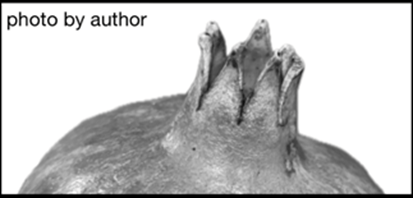
The inside of the pomegranate is blood red and can have over a thousand seeds. This speaks to Jesus’ bloodshed and the countless people saved by that blood. The appearance of these pomegranates embedded in the capital is like the bumps of the many scars that he had on his body from the beatings he endured. Just as the healed wounds of his hands and side could be seen and touched when Jesus offered them to Thomas, his other wounds would also be visible.
Carved into these capitals are lattices of checker depicting Jesus’ body marred by whips. “I gave my back to those who strike, and my cheeks to those who pull out the beard; I hid not my face from disgrace and spitting” (Isaiah 50:6), which led to his shocking appearance, even “as one from whom men hide their faces he was despised, and we esteemed him not” (Isaiah 53:3). As the whip lays down lines across his back, this way and that, it would form what appears as a latticework pattern in his flesh.
During the American Civil War, an escaped enslaved man known by only his first name, Gordon, joined the Union Army. While being fitted for his uniform, the soldiers saw a similar shocking appearance on his back from the whippings he had endured. They took a photo, and this infamous photo became known simply as “The Scourged Back.” It is a frightening reminder of what man can do to man and what men did to the Son of Man. The bumps of the pomegranates and the stripes of the latticework are decorative, to be sure, but in the darkest way. “And with his stripes, we are healed” (Isaiah 53:5, KJV), which is not a prophecy of metaphorical suffering but the literal reality of it.
The NIV translates 1 Kings 7:17 as, “interwoven chains adorned the capitals on top of the pillars, seven for each capital.” As can be seen in any police procedural television show, when a person is arrested, a careful chain of custody begins so that at no time is the prisoner not under the responsibility of lawful authority, from the police to the jailer to the judge in the courtroom, and so on. These seven chains represent how Jesus is bound under seven different authorities who maintain a chain of custody from his initial arrest in Gethsemane through his interrogations and beatings until he is led away to be crucified.
These seven are as follows: the soldiers in the Garden led by Judas, then Annas, Caiaphas, the assembly of the elders (the chief priests and scribes), Pilate, Herod, and ending with the governor’s soldiers and their cohort, who mocked him and then led him away to be crucified (John 18:12, 18:13, 18:24, Luke 22:66, Matthew 27:2, Luke 23:7, Matthew 27:27 to 31; John 19:16). Once he is arrested in Gethsemane, he is not free from human bondage until he rises to life on the third day; then, he is free not just from the chains of human bondage but from the bondage of death itself, freeing all of us from those chains as well. While for a time “he has made my chains heavy” (Lamentations 3:7), ultimately, he can proclaim, “O Lord…you have loosed my bonds” (Psalms 116:16).
Finally, on the tops of the pillars was lily-work, from which comes the fragrance of Jesus’ work on the cross, for “he shall blossom like the lily” (Hosea 14:5). The aroma rises to heaven, “a fragrant offering and sacrifice to God” (Ephesians 5:2). The large and empty flower atop the pillar would later, in manner of speaking, be filled by Nicodemus with “a mixture of myrrh and aloes, about seventy-five pounds in weight” (John 19:39). Theologian Richard Kidder (1633-1793) observes that “the bodies of great men were buried with great quantity of spices” and citing Jewish sources, says that this amount of spices “was enough for two hundred dead bodies.”
How fitting the Father, when looking down on his Son on the cross, sees this sweet offering as from an incense bowl, rising to heaven. “Has the Lord as great delight in burnt offerings and sacrifices, as in obeying the voice of the Lord? Behold, to obey is better than sacrifice” (1 Samuel 15:22), and “You are my beloved Son; with you I am well pleased” (Mark 1:11). Jesus is unique in his sacrifice, which in turn is uniquely pleasing to God.
The decorated capitals atop undecorated bare pillars speak to two historical events of that Passover week–Jesus on the cross and Jesus no longer on the cross. This may seem like mixed messaging, but it is precisely the point. Our salvation is based on both, and neither can be absent. Jesus dies on the cross to forgive sins but then conquers death through his resurrection. The Encyclopaedia Judaica notes that it is “difficult to discover the nature of the capitals; as the description of their construction is filled with unclear technical terms which do not appear elsewhere.” These technical terms are not found elsewhere, maybe because of the singularity of a Holy God who would sacrifice his Son for us.
Justice and Mercy
Significantly, the pillars have proper names and personifications, which no other items in the temple have. As the arriving worshipper faces the temple, Boaz, which translates to “in him is strength,” is on the north (right). Jachin, meaning “he will establish,” is on the south (left). In scripture, strength is often used to describe God’s administration of justice and establish is used to describe God’s mercy on his people when they fail.
Boaz. Justice requires strength that derives from the position of authority and the will to exercise that authority. A king is the only one with absolute power to execute justice without anyone questioning the decision. However, strength derives not only from the king’s position but also from that king’s will to act. Solomon says, “Divide the living child in two and give half to the one and a half to the other” (1 Kings 3:25). The power of his position, coupled with the complete confidence of his conviction, discerns the child’s true mother, and justice is served. The successful outcome of this dispute is based on Solomon’s authority to do this–and on the natural mother’s absolute certainty that he would do it.
By contrast, the lack of strength in Eli, a priest, and Judah, a king, shows how difficult it is to execute justice, even with legitimate authority. Eli is a faithful priest, but “his sons were worthless men, for the men treated the offering of the Lord with contempt” (1 Samuel 2:12-17) by stealing the meat from the sacrifices. Eli’s weakness in failing to correct this injustice results in his two sons dying on the same day, thus ending his legacy. Judah promises his daughter-in-law a husband but fails to keep that promise. He lacks the strength to give Tamar justice and ends up inadvertently (and sinfully) fathering her twins.
Finally, when Israel’s first high priest was anointed, “Moses took some of its blood and put it on the lobe of Aaron’s right ear and on the thumb of his right hand and on the big toe of his right foot” (Leviticus 8:23). This signified the strength to listen to God, the strength to act for God, and the strength to walk in God’s way. Justice and strength are bound together in one pillar. Boaz represents justice against us and our sins on the cross. In him is strength; the meaning of Boaz underlies this requirement to administer justice for our sins. God would give up his own Son for our sins, who had the strength of will to hear and obey. Jesus could do this, and Jesus did do this.
Jachin. Mercy comes because God promised to establish the Israelites in Canaan and us in his salvation. He does this despite our endless failures. Only the priest is given the permission and tools to offer mercy offered by God. But the “life of the flesh is in the blood” (Leviticus 17:11), and “without the shedding of blood there is no forgiveness of sins” (Hebrews 9:22), so mercy comes at a cost. That cost is the blood as represented in the priest’s sacrifices, yet “it is impossible for the blood of bulls and goats to take away sins” (Hebrews 10:4), so “Christ appeared as a high priest of the good things that have come; he entered once for all into the holy places, not by means of the blood of goats and calves but by means of his own blood, thus securing an eternal redemption” (Hebrews 9:11-12). And this is because he has mercy on us–and establishes us in him by grace.
After Abraham suggests Ishmael stand in as his promised heir, God says, “But I will establish my covenant with Isaac” (Genesis 17:21). During Paul’s ministry to the Thessalonians, he says, “For not all have faith. But the Lord is faithful. He will establish you and guard you against the evil one” (2 Thessalonians 3:2-3). Of Jesus, Isaiah says, “Of the increase of his government and of peace there will be no end, on the throne of David and over his kingdom, to establish it” (Isaiah 9:7). Look no further than Hebrews 11, the hall of fame of faith, to see that none of these saints are perfect. Still, they trust in God and not themselves to fulfill his promise to send a Savior. Similarly, the people in the genealogy of that Savior in Matthew and Luke are all imperfect sinners, but the Branch that saves us came through every one of them. God establishes us in him, for he made “an everlasting covenant” (Jeremiah 32:40) to redeem us.
Only God can judge justly and be merciful to save. Presbyterian pastor Stephen Charnock (1628–1680) says, “Believers have two immutable pillars for their support, stronger than those erected by Solomon, called Jachin and Boaz: these are election, or the standing counsel of God, and the covenant of grace. He will not revoke the covenant and blot the names of his elect out of the book of life.” The Psalmist says, “The earth feared and was still, when God arose to establish judgment, to save all the humble of the earth” (Psalms 76:9). The two pillars point to “his righteousness…so that he might be just [justice] and the justifier [mercy] of the one who has faith in Jesus” (Romans 3:26).
The Bases
While no description survives of the footings at the base of Jachin and Boaz, all the other pillars in the temple fit into crafted bases called sockets. The Barclay Talmud describes how all these “sockets were made with holes.” Because these pillars are of a single piece inserted into the ground, they must be raised from their prone position into these sockets. Anglican cleric Frederic Farrar (1831–1903) says of the installation of the cross, “The accursed tree was slowly heaved up by strong arms, and the end of it fixed firmly in a hole dug deep in the ground.” Solomon “raised up the pillars before the temple” (2 Chronicles 3:17, KJ21), and God promises, “I will raise up your offspring after you, one of your own sons, and I will establish his kingdom” (1 Chronicles 17:11).
Jesus says, “And I, when I am lifted up from the earth, will draw all people to myself” (John 12:32). He is lifted twice, once in the crucifixion and again in the resurrection. Oswald Chambers says, “When we preach our own experiences, people may be interested, but it awakens no real sense of need. But once Jesus Christ is lifted up, the Spirit of God creates an awareness of the need for Him.” Perhaps for this reason, a glass-encased hole within the Church of the Holy Sepulchre in Jerusalem, thought to be where that cross was fixed, remains one of the most revered and visited places for Christian pilgrims to Jerusalem.
The Builder
The crafter of these pillars previews the earthly life of Jesus. King Solomon hired Hiram to make the temple furnishings, who bears striking parallels to Jesus. “He was the son of a widow, his father was a worker in bronze, he was full of wisdom, understanding, and skill, He came to King Solomon and did all his work, He cast two pillars of bronze” (1 Kings 7:14-15). Like Hiram’s mother, Mary is likely a widow at the end because, on the cross, Jesus tells John, “Behold, your mother! And from that hour the disciple took her to his own home” (John 19:27). This instruction would not be needed if Joseph were still alive. Hiram and Jesus follow in their father’s footsteps as skilled laborers, one in bronze, the other in carpentry. Jesus’ good reputation is widely known, and, like Hiram, he “increased in wisdom and in stature and in favor with God and man” (Luke 2:52).
As Hiram does all the work that King Solomon asks for, Jesus comes “to do the will of him who sent me and to accomplish his work” (John 4:34). He “accomplished the work” (John 17:4) and then on the cross cries out, “It is finished” (John 19:30). Hiram ensured the pillars were finished before any other temple furnishings were started, just as Jesus’ work on the cross had to be completed before the temple curtain could be torn in two to bring down the dividing wall between God and us. He was raised up in three days with the temple of his own body and is now ministering and interceding for us in heaven.
In His Hand
Something can also be understood from the pillars’ placement in the vestibule in front of the temple, Jachin to the south and Boaz to the north, to the left, and the right as the worshipper approached the temple. These also point to the two triumphs of mercy and justice on the cross.
Authority and power are often described as coming from the right hand, administering justice, and superseding human will. “Your right hand, O Lord, shatters the enemy” (Exodus 15:6), and Jacob crosses his hands so his right hand will bless the younger son against tradition and Joseph’s request (Genesis 48:17).
The left hand is often associated with God’s mercy. The Psalmist says, “I am continually with you; you hold my right hand” (Psalms 73:21-24, Psalms 109:31). Also, “For I, the LORD your God, hold your right hand; it is I who say to you, ‘Fear not, I am the one who helps you’” (Isaiah 41:13). If Jesus is holding our right hand, he is holding it with his left hand, mercifully guiding us as we navigate the difficulties in this life. “For God did not send his Son into the world to condemn the world, but in order that the world might be saved through him” (John 3:17). He does this despite our rejection of him. In Jesus are justice and mercy. He is “seated at the right hand of Power” (Mark 14:62) but uses that power to “intercede for us” (Romans 8:34).
Two Points of View
Just as Jesus is raised naked and in shame on Calvary, these pillars are exposed on every side. However, not having any structure above, they are unobstructed from heaven’s view, so what is seen in them is a matter of perspective. When we look up, we see a crown of thorns; when his Father looks down, he sees a crown of glory. When we look up, we see a weak and dying man who “cannot save himself” (Matthew 27:42); when his Father looks down, he sees the strength of the only man who ever lived a sinless life yet endured the weight of our sin and the fury of his wrath. When we come near the cross, we smell the stench of death; when his Father comes near the cross, he smells the fragrance of an obedient and suffering Savior. When we look up, we see a mere man; when his Father looks down, he sees his own Son. But when we see what the Father sees, we see a suffering servant and a path between two pillars into his presence in the true temple.
When the sun rises, the highest object is the first thing that gets illuminated. On top of the capital, the lily bowl catches those first rays of light. This is the first image we see when the darkness of our sinful heart begins to fade, and we are attracted to that sweet-smelling offering to heaven. But as the sunlight works its way down the capital, we see the cost of that sweet smell, a suffering servant, and the decorations of his abused body. Finally, we see the rest of the pillar void of decoration as Jesus’ suffering has ended, and he gained victory over death.
Like these two pillars in front of the temple, Jesus on the cross, crucified for us, stands astride history where justice and mercy meet, as the Son of God receiving justice for our sins, and the Son of Man providing us the gift “To enter the holy places by the blood of Jesus” (Hebrews 10:19). It is the first temple furnishing we see, and the first furnishing we must see and then pass between to fellowship with Jesus and each other. When Joseph interpreted Pharaoh’s dream, he said, “And the doubling of Pharaoh’s dream means that the thing is fixed by God, and God will shortly bring it about” (Genesis 41:32). That Jesus would come to save us was decided since our fall from grace, and the two identical pillars indicate that God indeed fixed our salvation from the beginning.
Finally, we see the undecorated pillars bare like the cross because Jesus is resurrected. God’s justice and mercy are bound up in his only Son. He died on top of a cross but has risen from that cross and ascended to the Father’s right hand, mediating for us day and night. “I am the root and the descendant of David, the bright morning star” (Revelation 22:16).
Many yearn for a deeper connection to these events in an Easter week ritual called The Passion of the Christ, visualizing his torture, crucifixion, and death. It can be in the form of a live performance, movie, or even conducted in public places during the Lenten season, with people acting out the biblical narrative in front of mourning onlookers. This has not always been so. The Encyclopaedia Biblica remarks that “Modern realism takes interest in these painful details which was unknown to primitive Christianity and to the [first] evangelists,” who took an interest in it only to see Jesus’ “wonderful character” and use it as proof of “prophecies fulfilled,” showing he was indeed the promised Messiah.
These pillars might be seen as the original Passion Play–a representation of what the Messiah would go through for those people in ancient days who might look forward and believe in him by faith, and for those of this age to look back and not forget the price paid for our faith. “For I decided to know nothing among you except Jesus Christ and him crucified” (1 Corinthians 2:2). When Babylon conquered Jerusalem, it is noted, “As for the two pillars, the one sea, and the stands that Solomon had made for the house of the LORD, the bronze of all these vessels was beyond weight” (2 Kings 25:16). Indeed, the value of Jesus’ victory over death is similarly beyond measure, as was his Passion.
Two Equals One
The original moving tabernacle pillars of God’s glory in the desert, they are actually one pillar–a cloud by day, “and fire was in it by night” (Exodus 40:38)–so, too, these two pillars have one purpose and meaning. God loves us and leads us through this earthly desert into his rest. As the cloud led them by day, and the fire gave them light “that they might travel by day and by night” (Exodus 13:21), these two pillars always lead us into Jesus’ Tabernacle presence. As the Psalmist says, “The sun shall not strike you by day, nor the moon by night. The LORD will keep your going out and your coming in from this time forth and forevermore” (Psalms 121:6, 8). Jesus is here for us, in our brightest and day and in our darkest night.
Professor Frederic Thieberger, teacher, translator and Jewish philosopher, speculates a translation of the pillars’ names into a single thought could be considered: “Or are both phrases to be taken as one sentence, Jachin-Boaz meaning: ‘He will set up with strength’? But then we come up against this difficulty: the subject of the sentence must be God, yet there is no object. What will he set up?” Thieberger’s puzzlement has precisely identified the uniqueness of Jesus in history. For the answer is that the subject and the object are one and the same: Jesus, both God and Lord.
David knew this–and Jesus quotes him in telling the Pharisees who is, “The Lord said to my Lord, “Sit at my right hand, until I put your enemies under your feet”’? If then David calls him Lord, how is he his son?” (Matthew 22:44-45). Their response indicates their understanding of the conundrum, for “no one was able to answer him a word, nor from that day did anyone dare to ask him any more questions” (Matthew 22:46). The pillars, separate but identical, anticipate Jesus, fully divine and fully human, fully God in Heaven and fully Lord of this earth.
The King Between
When King Joash is crowned, the Amplified Bible says, “There stood the [young] king [on the platform] by the pillar, as was customary” (2 Kings 11:14). The Cambridge Bible notes that “the word ‘pillar’ is the same used for the two, Jachin and Boaz.” John Gill’s Exposition of the Entire Bible notes that some think this platform was the brazen scaffolding erected by Solomon, spoken of in 2 Chronicles 6:13. Gill goes on to note, “This throne was like an high tower, standing upon two pillars…in the place where kings used to sit or stand.”
It is appropriate that Israel’s kings secure their rule elevated in glory lifted between the pillars of Jachin and Boaz. The true King, risen in glory above all others, sits at the right hand of God based on the saving work he did on the cross, as seen in the pillars of Jachin and Boaz. He is “King of kings and Lord of lords” (Revelation 19:16) and “Of the increase of his government and of peace there will be no end, on the throne of David and over his kingdom, to establish it and to uphold it with justice and with righteousness from this time forth and forevermore” (Isaiah 9:6-7). In him, we have an assurance to join him there, for he promises,
“I am coming soon. Hold fast what you have, so that no one may seize your crown. The one who conquers, I will make him a pillar in the temple of my God. Never shall he go out of it, and I will write on him the name of my God, and the name of the city of my God, the new Jerusalem, which comes down from my God out of heaven, and my own new name.” (Revelation 3:11-12)
In His Hands
As a final note, shortly after Jesus begins his ministry, he chooses his hometown synagogue in Nazareth to give his inaugural public sermon. He reads aloud from Isaiah for his text, “The Spirit of the Lord is upon me, because he has anointed me to proclaim good news to the poor. He has sent me to proclaim liberty to the captives and recovering of sight to the blind, to set at liberty those who are oppressed, to proclaim the year of the Lord’s favor” (Luke 4:18).
In the liturgical formality of this moment, “the scroll of the prophet Isaiah is given to him,” and after Jesus reads the text, “he rolled up the scroll and gave it back to the attendant” (Luke 4:17, 20). Consider that on either side of this text is the rest of the scroll wrapped around two posts Jesus holds. How appropriate that Jesus, the pillars through whom we must pass for entry into the heavenly temple, read these words about himself, set between two literal posts, like pillars, announcing his eagerly anticipated arrival.
The name of the wooden dowel of the scroll’s post has a beautiful significance. Rabbi Menachem Posner notes in his essay, “Etz Chayim: The Tree of Life in the Bible and Beyond,” that the Hebrew word for the post used to wrap the scroll is “atzei chaymin” and explains, “In Hebrew, the word ‘etz’ can refer to either a ‘tree’ or ‘wood.’ Thus, the wooden dowels around which a Torah scroll is wrapped are often called atzei chayim, ‘woods of life.’” As John writes, “In him was life, and the life was the light of men” (John 1:4).
Between these two Trees of Life exists a picture of God’s grace spanning all scripture. From the Fall in Eden through to the New Jerusalem are the words describing the intentionality and persistence of his mercy and grace for our deliverance through the Word incarnate. God is faithful in working through people and history, and his only Son is to restore us to himself. Theologian Thomas Goodwin (1600–1680) says, “he should gather together in one the children of God that were scattered abroad. All the Gentiles that were scattered, Christ’s death to gather them together in one, all them that belong to God’s election, both in that age, and in all ages to the end of the world.” As Isaiah says, “He will raise a signal for the nations and will assemble the banished of Israel, and gather the dispersed of Judah from the four corners of the earth” (Isaiah 11:12).
This essay is part of Shadows of Christ: Twelve Essays.
 thegospeloneverypage.com